
Teaching Against the Grain
Rereading Richard Rodriguez

There are things so deeply personal that they can be revealed only to strangers.
--Richard Rodriguez
In a graduate course called “Stories of Teaching” that I’m teaching this term, we’re reading memoirs of education told from either the student’s or the teacher’s point of view. This is a course I’ve taught several times over the years, and I’ve always found it interesting to observe the responses to the books on my syllabus, a few of which endorse political positions not in keeping with the Leftist assumptions of graduate students in an English department.
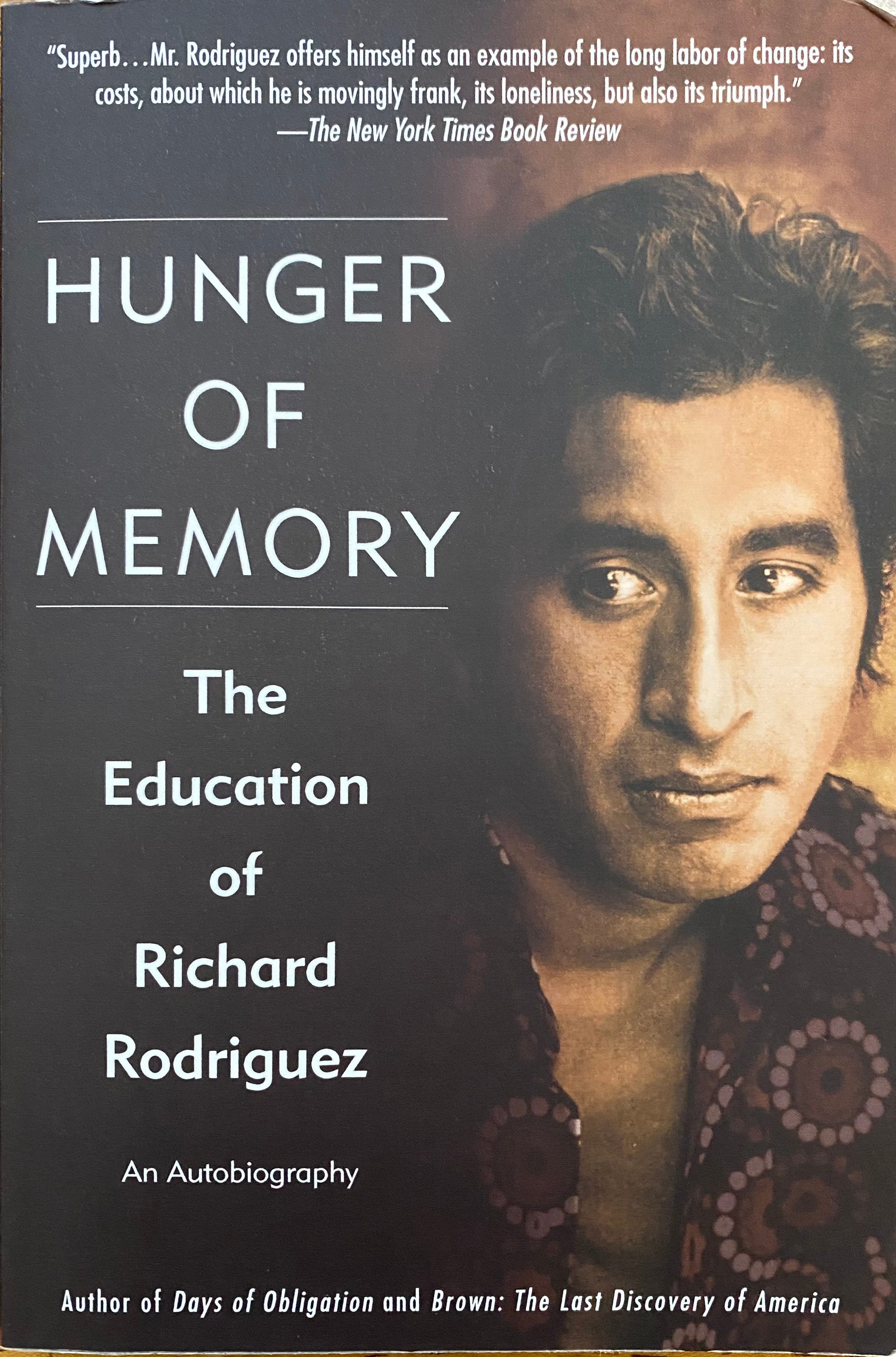
A case in point: Hunger of Memory by Richard Rodriguez, which always stirs resistance, sometimes even disdain, among my students. Published in 1982, the book traces Rodriguez’s path from his humble beginnings as a second-generation Mexican immigrant who begins first grade able to speak only Spanish, to the conclusion of his studies at Stanford, where he earns a PhD in English literature but turns down, in a personal protest against Affirmative Action, multiple job offers from prestigious universities. By the time his book came out, Rodriguez was already a darling on the Right and a pariah on the Left, though a careful reading suggests he embraced neither side, hoping instead to be taken seriously by all for what his experience taught him about the education of marginalized students.
Most of my graduate students over the years have found Rodriguez’s opposition to Affirmative Action and bilingual education hard to stomach, and I sometimes underestimate the challenge this can create for class discussion. This semester was no exception. I began by asking for some general impressions—maybe not the best way to begin with a book like this one—and the negative reactions surfaced immediately, though this group of students expressed them far more politely than did those from past iterations of the course. Still, I quickly felt my back against the wall, wondering whether I should defend the book’s merits or simply accept that students found it ideologically unacceptable.
What are those merits? Well, one way to regard this book is not as a political tract but as an elegy for what Rodriguez believes his education cost him: intimacy with his family. Like many other working-class kids who’ve gone on to become accomplished first-generation college graduates, Rodriguez found that his achievements in school gradually separated him, through language and culture, from the parents who raised him. But the irony is that while he intends his book to celebrate his successful entry into mainstream society, it is far more memorable as a requiem to his upbringing, for the passages about what he’s left behind are far more convincing than those about what he’s gained. The very same coming-of-age story, wherein a family sacrifices their native tongue for the sake of success in school, could have been used as an argument for bilingual education instead of against it.
I realize this might be seen as a backhanded compliment, but to me there’s much to appreciate about this memoir even if I don’t come to the same conclusions about educational policy that Rodriguez does. And that’s exactly what I want my students to notice: that a book’s value doesn’t depend solely on its politics. As it happens, I think Rodriguez raises tough questions about Affirmative Action (which he thinks should stress class over race) and bilingual education (which he thinks inhibits students’ movement toward assimilation), though I often don’t accept his all-or-nothing assumptions. At a time when those on “the other side”—whichever side it is—get condemned before they even speak, I’d like students to read a book like Hunger of Memory with enough generosity that they can recognize its power and empathize with its writer despite his ideology. In doing so, they might even learn that Rodriguez’s politics are less predictable than they’ve presumed, as when he complains that the problem with Affirmative Action based on race is that it isn’t transformative enough—not exactly the argument you expect to hear from a conservative.
Fortunately, the graduate students in my course this term are among the most open-minded I’ve encountered in a long while, and their compassion soon emerged alongside their critique. But when class ended with so much left unsaid, I found myself longing to give a mini-lecture on why I value Rodriguez’s book. Usually I take a Socratic approach to my classes, doing my best to engage students through questions that rouse their thinking and encourage them to see the subtleties in texts they might otherwise merely dismiss. But sometimes—as has often been the case with Rodriguez’s book over the years—I find that questioning isn’t enough, or at least that I haven’t located the questions that might lead students toward a more nuanced response. And when our time with the book elapses, with the syllabus pushing us toward whatever’s next, I return to my office to reflect on my failure, searching for an approach that might be more productive the next time I teach the course.
This semester I did something else: I adjusted the syllabus so that we could devote an additional class to Hunger of Memory, and I began that class with fifteen minutes of remarks about what I think this book has to offer. I spoke, as I have here, about texts that gain power indirectly, through effects that seem to go against what their author intends, and about how those of us in the Humanities should beware of becoming too ideologically comfortable, too settled in our views. In short, I said that we need to grant Rodriguez the integrity of his experience and strive to understand why it affected him as it did, whether or not we find ourselves politically aligned with his analysis. As a story of teaching and learning, his book is a moving testimony of both pain and gain, and what I want most when teaching it is that it not be reduced to a policy statement.
I can’t say what effect my mini-lecture had on my class—whatever we think we know about how our students respond to us, it’s surely a mere fraction of the tale—but I was pleased that we went on to have what seemed to be a more edifying conversation, one that included some reflection on Rodriguez’s final chapter, where he discusses the challenges of writing a memoir that involves parents who don’t understand why he would share his personal experiences with the public. From his parents’ perspective, such experiences are deeply private and have no place beyond the family. While he’s respectful of their position (more respectful than most memoirists, I’d argue), he ultimately embraces the central paradox of memoir—that there are “things so deeply personal that they can be revealed only to strangers.” That he gives considerable space to exploring this paradox is another reason why I value his book.
I doubt that my graduate students are now eager to teach Hunger of Memory once they become teachers themselves—and that’s okay. But sometimes the conflict between how a teacher and their students see a book is well worth bringing into the open air, if only to stimulate further thinking on both sides. I find myself resistant to Rodriguez’s political assumptions yet pulled into the story of his remarkable education every time I read this book, and I’ll continue to seek the instructive tensions that come from this kind of life on the page.
I taught this book a few times in the 80s, when it first came out. My reading was and is closer to yours, most likely (thinking about it in retrospect) for autobiographical and class-related reasons. The resistances back then in racially diverse freshman comp classes were equally intense but more varied than the ones you report. Your extra class session was worthwhile if only to illustrate how vexatious it can be to understand another human life, no matter how much “information” you have, including their own well-documented testimony, an almost impossible project even in the best of times, which are not these times. I’m inclined at my age to think that misunderstanding others is a chronic state in human affairs, and any attempts to mitigate it are deeply worthy, even if they may feel (or be) futile.
Interesting. I have never read Rodriguez’s book, but it strikes me (after reading Hillbilly Elegy long ago) that this is the view of Affirmative Action held by J.D. Vance. Vance overcame his class differences in the Ivy League and survived by learning to assimilate from Usha. He is a master chameleon—dangerous because he is driven by ambition with no moral center. I suspect Rodriguez has a more compassionate, measured view of these issues. But I’m glad your students realize the danger in this kind of thinking.